


A merchant loses fractions of a percent on every hour a parcel of rough diamonds sits idle in transit. When you move 100,000 carats a month, those idle hours compound into tens of thousands of dollars lost. For global merchants, relying on fragmented networks is no longer sustainable; modern trading demands a unified, highly optimized diamond business infrastructure to secure margins. The industry has outgrown the model of disjointed operations where trading offices, manufacturing units, and customs brokers operate miles apart. True operational efficiency is not about faster transport; it is about eliminating transport altogether. By housing every step of the supply chain under a single roof, merchants can protect their capital and streamline their operations.
The friction point of physical transit in high-value trading
In traditional diamond hubs, a single transaction requires a complex web of logistics. A dealer buys rough stones in one building, sends them to a separate facility across town for boiling and sorting, moves them to another office for grading, and then rents secure vehicles to transport them to a customs port. Each leg of this journey introduces security risks, administrative overhead, and insurance costs.
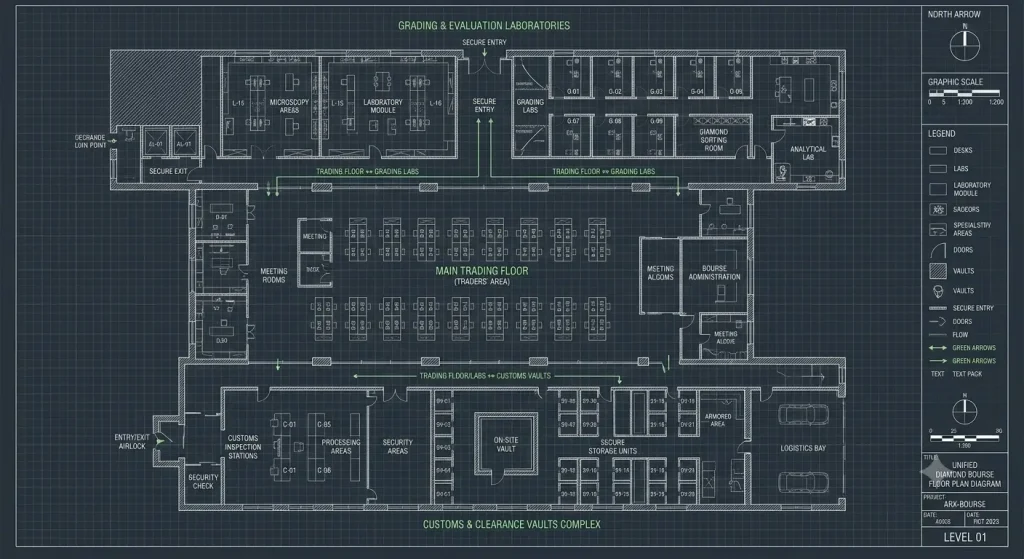
When you analyze the ledger, these inefficiencies represent a massive tax on your liquidity. To avoid this, world-class hubs are shifting toward fully consolidated office spaces. Having trading, grading, and logistics in one location means that a transaction that used to take three days now takes thirty minutes. This is not just a convenience; it directly affects your bottom line by increasing the velocity of your capital.
Consider the process of diamond cutting and polishing. When the manufacturing units are miles away from the trading desks, the feedback loop between the market demands and the factory floor is broken. If a merchant receives a sudden request for a specific cut, they must coordinate across multiple locations. In a consolidated hub, the merchant can walk down the hall to the production coordinator, reducing the response time to a fraction of the usual duration.
Securing the supply chain inside modern diamond business infrastructure
Security is the bedrock of any diamond enterprise, but traditional security measures often introduce operational friction. Heavy gates, slow clearance procedures, and multiple checkpoints can paralyze daily business. The challenge is to maintain maximum security without slowing down the movement of goods and people.
The solution lies in smart design. Modern diamond business infrastructure uses zoned access controls and integrated vault systems to secure assets invisibly. By utilizing on-site high-security vault facilities, merchants can deposit and withdraw their inventory without exposing it to the public sphere. These vaults are connected directly to the trading floors via secure elevators and monitored corridors.
This structural integration has a direct impact on insurance premiums. Lloyds of London and other major underwriters assess risk based on the number of hand-offs and open-air transits. When you eliminate the street-level transport from your daily routine, you immediately lower your risk profile. This design allows merchants to handle high-value consignments with peace of mind, knowing that the physical environment is built to absorb risk.
The true cost of customs bottlenecks
Customs delays are the silent killer of international trading margins. A parcel of polished diamonds sitting in a customs warehouse at an airport is a non-productive asset. If your business operates internationally, you are likely familiar with the frustration of waiting for local custom officers to clear import-export documentation, especially during peak trading seasons.
To bypass this bottleneck, a modern trading hub must incorporate a dedicated direct customs clearance services branch within its physical perimeter. Having a dedicated customs clearance ring inside the bourse means that international shipments can be cleared, inspected, and vaulted within hours of arrival. This removes the need for high-risk, expensive armored transport to off-site customs facilities.
This integration also ensures strict compliance with international regulations, including the Kimberley Process Certification Scheme. When government officials and independent appraisers work in the same building as the traders, the verification process becomes faster and more reliable. This level of institutional integration is what separates an international bourse from a simple office building.
“The most expensive diamond is the one stuck in transit. When your capital is frozen in customs paperwork, you are not trading: you are financing bureaucracy.”
Secure Your Position in Global Trade
Streamline your supply chain, eliminate transit vulnerabilities, and accelerate your capital velocity. Join the elite network of global merchants operating from the world’s most advanced diamond ecosystem.
Frequently asked questions
How does on-site customs clearance speed up international diamond shipments?
By housing a dedicated customs office within the bourse, shipments do not need to be transported to off-site warehouses. Appraisers and customs officials can verify and clear parcels within the building, reducing processing times from days to hours.
Are the security vaults accessible 24/7 for merchants?
Yes, the vault facilities operate under continuous high-security protocols, allowing authorized merchants to secure or retrieve their assets under strict surveillance at any time, matching the global pace of diamond trading.
What measures are in place to prevent power interruptions during laser cutting?
The infrastructure features dual-source grid connectivity along with high-capacity backup generators and uninterruptible power supply (UPS) systems to ensure that sensitive laser machinery operates without any voltage drops.
How does a unified bourse help reduce insurance premiums for traders?
Underwriters rate risk based on transit exposure. By keeping trading, grading, and vaulting within a single secure perimeter, you eliminate street transit, which significantly lowers your overall operational risk profile and premium costs.
Can international buyers access secure viewing rooms for private negotiations?
Yes, the bourse provides specialized, high-security viewing rooms equipped with optimal northern lighting and advanced testing equipment where private transactions can be conducted safely.