

Surat Diamond Bourse website loading spinner
Surat Diamond Bourse office building and modern architecture header

A merchant loses fractions of a percent on every hour a parcel of rough diamonds sits idle in transit. When you move 100,000 carats a month, those idle hours compound into tens of thousands of dollars lost. For global merchants, relying on fragmented networks is no longer sustainable; modern trading demands a unified, highly optimized diamond business infrastructure to secure margins. The industry has outgrown the model of disjointed operations where trading offices, manufacturing units, and customs brokers operate miles apart. True operational efficiency is not about faster transport; it is about eliminating transport altogether. By housing every step of the supply chain under a single roof, merchants can protect their capital and streamline their operations.

The friction point of physical transit in high-value trading

In traditional diamond hubs, a single transaction requires a complex web of logistics. A dealer buys rough stones in one building, sends them to a separate facility across town for boiling and sorting, moves them to another office for grading, and then rents secure vehicles to transport them to a customs port. Each leg of this journey introduces security risks, administrative overhead, and insurance costs.

When you analyze the ledger, these inefficiencies represent a massive tax on your liquidity. To avoid this, world-class hubs are shifting toward fully consolidated office spaces. Having trading, grading, and logistics in one location means that a transaction that used to take three days now takes thirty minutes. This is not just a convenience; it directly affects your bottom line by increasing the velocity of your capital.

Consider the process of diamond cutting and polishing. When the manufacturing units are miles away from the trading desks, the feedback loop between the market demands and the factory floor is broken. If a merchant receives a sudden request for a specific cut, they must coordinate across multiple locations. In a consolidated hub, the merchant can walk down the hall to the production coordinator, reducing the response time to a fraction of the usual duration.
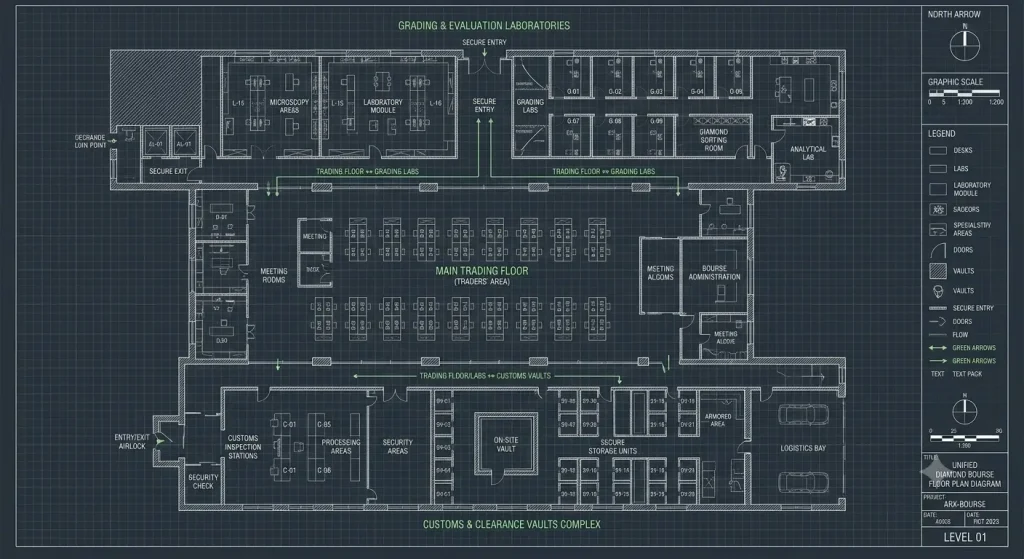
Securing the supply chain inside modern diamond business infrastructure

Security is the bedrock of any diamond enterprise, but traditional security measures often introduce operational friction. Heavy gates, slow clearance procedures, and multiple checkpoints can paralyze daily business. The challenge is to maintain maximum security without slowing down the movement of goods and people.

The solution lies in smart design. Modern diamond business infrastructure uses zoned access controls and integrated vault systems to secure assets invisibly. By utilizing on-site high-security vault facilities, merchants can deposit and withdraw their inventory without exposing it to the public sphere. These vaults are connected directly to the trading floors via secure elevators and monitored corridors.

This structural integration has a direct impact on insurance premiums. Lloyds of London and other major underwriters assess risk based on the number of hand-offs and open-air transits. When you eliminate the street-level transport from your daily routine, you immediately lower your risk profile. This design allows merchants to handle high-value consignments with peace of mind, knowing that the physical environment is built to absorb risk.

The true cost of customs bottlenecks

Customs delays are the silent killer of international trading margins. A parcel of polished diamonds sitting in a customs warehouse at an airport is a non-productive asset. If your business operates internationally, you are likely familiar with the frustration of waiting for local custom officers to clear import-export documentation, especially during peak trading seasons.

To bypass this bottleneck, a modern trading hub must incorporate a dedicated direct customs clearance services branch within its physical perimeter. Having a dedicated customs clearance ring inside the bourse means that international shipments can be cleared, inspected, and vaulted within hours of arrival. This removes the need for high-risk, expensive armored transport to off-site customs facilities.

This integration also ensures strict compliance with international regulations, including the Kimberley Process Certification Scheme. When government officials and independent appraisers work in the same building as the traders, the verification process becomes faster and more reliable. This level of institutional integration is what separates an international bourse from a simple office building.

“The most expensive diamond is the one stuck in transit. When your capital is frozen in customs paperwork, you are not trading: you are financing bureaucracy.”

Building your presence in the world’s primary diamond hub

The Surat Diamond Bourse represents the physical realization of these principles. As the world’s largest single-office building, SDB was engineered from the ground up to eliminate the friction points that plague traditional traders. By combining trading offices, customs clearance, security vaults, and testing laboratories into a single, cohesive structure, SDB offers an unmatched environment for growth.

Integrating your operations within a world-class diamond business infrastructure is the difference between leading the market and chasing it. If you want to secure your supply chain, reduce your operational overhead, and position your brand at the center of global trade, explore our fully consolidated office spaces today.

Secure Your Position in Global Trade

Streamline your supply chain, eliminate transit vulnerabilities, and accelerate your capital velocity. Join the elite network of global merchants operating from the world’s most advanced diamond ecosystem.

Explore Premium Office Spaces

Frequently asked questions

How does on-site customs clearance speed up international diamond shipments?

By housing a dedicated customs office within the bourse, shipments do not need to be transported to off-site warehouses. Appraisers and customs officials can verify and clear parcels within the building, reducing processing times from days to hours.

Are the security vaults accessible 24/7 for merchants?

Yes, the vault facilities operate under continuous high-security protocols, allowing authorized merchants to secure or retrieve their assets under strict surveillance at any time, matching the global pace of diamond trading.

What measures are in place to prevent power interruptions during laser cutting?

The infrastructure features dual-source grid connectivity along with high-capacity backup generators and uninterruptible power supply (UPS) systems to ensure that sensitive laser machinery operates without any voltage drops.

How does a unified bourse help reduce insurance premiums for traders?

Underwriters rate risk based on transit exposure. By keeping trading, grading, and vaulting within a single secure perimeter, you eliminate street transit, which significantly lowers your overall operational risk profile and premium costs.

Can international buyers access secure viewing rooms for private negotiations?

Yes, the bourse provides specialized, high-security viewing rooms equipped with optimal northern lighting and advanced testing equipment where private transactions can be conducted safely.

Every year, millions of carats of rough diamonds make a redundant, multi-leg journey before reaching the retail market. They land in primary trading centers, get shipped to secure storage in major hubs, travel over land to specialized cutting facilities, and then return to those same trading centers for grading and sale. This fragmented loop creates massive overhead, adding unnecessary transit insurance premiums and security risks. The surat diamond bourse directly resolves this structural inefficiency by consolidating the entire diamond pipeline, from raw import to final export, inside a single ultra-secure perimeter. By eliminating the physical distance between manufacturing units and international trading desks, the facility removes days of transit delay and reduces the cost of secure custody.

For decades, the global industry accepted this geographic separation as an unavoidable cost of business. Manufacturers in Gujarat cut and polished ninety percent of the world’s stones, yet had to send finished goods to Mumbai or overseas to execute international sales. This structural gap delayed cash flow and increased exposure to market volatility during transit. Consolidating these operations under one roof changes the financial physics of diamond trading, offering an integrated environment where a stone can be cut, certified, traded, and exported without leaving the building.

Consolidating the Fragmented Diamond Pipeline

The traditional journey of a diamond is a logistical challenge. A parcel of rough diamonds purchased in Antwerp or Dubai travels to Mumbai, undergoes secure transit to Surat, gets distributed to local workshops, returns to Mumbai for grading, and finally gets exported. Each leg of this trip requires separate security details, armored transport, and specialized insurance coverage. This constant movement exposes high-value cargo to loss and administrative delays at customs checkpoints.

By establishing a centralized trading ecosystem in DREAM City, the industry bypasses these redundant steps. Buyers can purchase rough stones, hand them directly to localized cutters, and receive the polished outcomes in a matter of days. This level of proximity speeds up the velocity of capital, allowing dealers to reinvest their cash far faster than traditional pipelines allow. Operational details regarding early lease structures and spatial integration during the initial phases of this consolidation are documented in the August 2022 Compendium.

Is physical consolidation worth the relocation cost?

Relocating established trading desks from traditional hubs to a new center involves significant upfront investment. Critics often point to the deep-seated relationships in older markets as a barrier to adoption. However, the financial benefit of direct integration outweighs these transition friction points. When a firm operates inside a unified hub, it eliminates the daily courier costs and risk premiums associated with moving high-value inventory between cities.

From a pure balance sheet perspective, the reduction in cycle time from rough sorting to final sale frees up substantial working capital. Instead of having inventory tied up in transit for seven to ten days, merchants can complete transactions instantly. This efficiency is especially vital in high-interest rate environments where holding costs can quickly erode the thin margins of the diamond sector. The physical proximity of trading floors to polishing wheels means that feedback loops on cutting quality are instantaneous, reducing waste and improving yield on high-value rough stones.

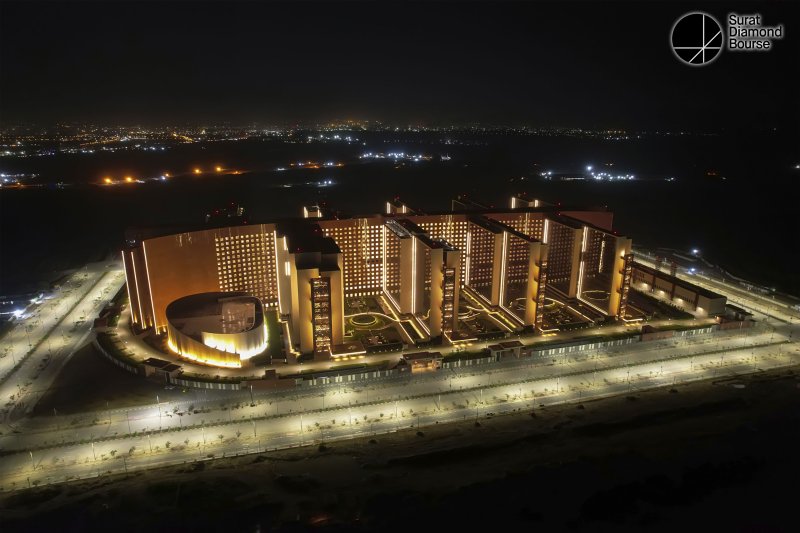
Night Aerial View of Illuminated Surat Diamond Bourse

Optimizing Logistics Within the surat diamond bourse

Architectural scale in commercial real estate is often a vanity metric, but in high-value logistics, physical design dictates operational speed. The massive layout of the facility, spanning over 6.7 million square feet across nine interconnected rectangular towers, is engineered specifically to minimize foot transit times. A central spine connects every tower, ensuring that any office is accessible from the main entrance in less than four minutes. This layout is a deliberate attempt to optimize daily B2B interactions.

This internal connectivity means that brokers, manufacturers, and buyers can execute dozens of viewings a day without leaving the secure zone. In contrast to traditional, scattered urban markets where visiting five suppliers might require navigating hours of dense traffic, this layout functions as a vertical city. The progression of office allotments and internal infrastructure setup during the final construction phases is detailed in the September 2022 Compendium.

The physical layout also factors in the unique environmental needs of diamond grading. Natural north light is highly prized by traditional diamond assortors for evaluating color. The architectural design of the towers ensures that a significant portion of the offices receive consistent, indirect north light throughout the day, reducing the reliance on artificial grading lights and preserving traditional valuation methods.

Can a single building eliminate export customs bottlenecks?

The biggest point of friction in international diamond trading is not the physical cutting, but the regulatory paperwork. Customs clearances often require transporting goods to distant international airports under heavy guard, waiting for physical inspections, and dealing with off-site administrative delays. The inclusion of a dedicated, in-house Customs Clearance House (CCH) within the facility solves this operational issue completely.

Having customs officers stationed directly inside the trading perimeter allows merchants to declare, inspect, and seal international shipments on-site. Once cleared, secure logistics partners transport the sealed parcels directly to the tarmac of the nearby airport. This process cuts export processing times from several days to a few hours, transforming how international buyers interact with the Indian manufacturing sector.

The Financial and Security Infrastructure of Modern Trading

High-volume diamond trading requires a delicate balance of heavy physical security and frictionless movement. Traditional markets often struggle with outdated infrastructure, relying on manual security checks that slow down business. The modern approach implemented here uses automated, multi-tiered security systems that protect assets without causing bottlenecks at office entrances.

From biometric access control systems to sophisticated safe vaults managed by international security firms, the building acts as a secure container. This allows small and medium-sized enterprises to access institutional-grade security that would be cost-prohibitive to install in an isolated office. The operational protocols and security dry runs that established these parameters are discussed in the October 2022 Compendium.

The presence of on-site banking institutions and secure vaulting facilities also simplifies the transaction settlement process. Instead of waiting for wire transfers to clear while goods sit in a third-party warehouse, buyers and sellers can execute simultaneous delivery-versus-payment transactions. This real-time settlement reduces counterparty risk, which is a major concern in high-value, low-margin gem trading.

Why does local grading integration change manufacturing speed?

A polished diamond remains a commodity without a recognized certificate. Historically, the gap between finishing a stone and receiving its official grade from gemological laboratories was a major supply chain drag. Sending parcels to external labs created security risks and took expensive inventory out of circulation for weeks.

By hosting major grading laboratories on-site, the facility enables instant handovers. A manufacturer can walk a newly polished stone across the central corridor to a laboratory, obtain a digital or physical certificate, and list it on the global trading market the same afternoon. This immediate turnaround eliminates the traditional “dead time” in the supply chain, improving liquidity for manufacturers of all sizes.

Al-fresco meeting area and recreational zone at Surat Diamond Bourse

Reducing the Carbon and Financial Cost of Supply Chain Intermediaries

Beyond the immediate logistical benefits, consolidating the trade reduces the environmental footprint of the jewelry supply chain. The traditional multi-city transit model relies heavily on armored flights and secure road transport, both of which carry high carbon footprints per carat. By centralization, the industry significantly lowers its reliance on regional shipping networks.

At the same time, this consolidation minimizes the role of secondary brokers who profit from the physical distance between manufacturers and buyers. Direct trading platforms within the bourse allow international jewelry brands to establish direct relationships with the cutting facilities, improving transparency and traceability from rough sourcing to retail-ready stones.

Can small-scale manufacturers survive in a massive corporate hub?

A common concern during the development of mega-projects is the displacement of smaller players who cannot afford premium real estate. The developers of this facility addressed this by offering varied office sizes, ranging from small trading booths to expansive corporate suites. This design ensures that independent artisans and small-scale polishers remain integrated into the primary trading flow.

By keeping small manufacturers in the same physical space as global buyers, the bourse democratizes access to international markets. Small operators no longer have to sell their polished goods to domestic middlemen at discounted rates. They can present their inventory directly to international sourcing agents, securing fairer market pricing and boosting local economic resilience. This proximity also encourages technology transfer, as smaller shops can observe and adopt the advanced laser-cutting and planning tools used by larger firms nearby.

To capitalize on these operational efficiencies, global trading houses are adapting their logistics with the latest frameworks outlined in the surat diamond bourse operational updates. Review the complete transaction rules and space allocation details in the October 2022 Compendium to optimize your supply chain presence.

Secure Your Space in the World’s Largest Diamond Hub

Position your business at the center of the global diamond pipeline. Connect directly with manufacturers, grading labs, and international customs clearance under one ultra-secure roof at the Surat Diamond Bourse.

Explore Space Allotments

Frequently asked questions

How does the facility compare in size to other global diamond hubs?

The facility is the largest single office building in the world, spanning over 6.7 million square feet. This surpasses traditional hubs like the Bharat Diamond Bourse in Mumbai and Antwerp’s diamond district in terms of single-roof physical footprint, consolidating thousands of offices into one interconnected complex.

What security protocols are used to protect high-value inventory?

The complex features a multi-tiered security system, including biometric access control, advanced safe vaults, continuous video surveillance, and secure entry gates. These measures ensure that high-value cargo is protected at all times without disrupting the daily flow of thousands of traders and buyers.

Can international buyers access direct customs clearance on-site?

Yes, the facility includes an in-house Customs Clearance House (CCH). This allows international buyers to complete all import and export inspections, appraisals, and documentation within the secure perimeter, bypassing regional transit checkpoints and expediting direct air shipments.

How does the integration of grading labs affect transaction speeds?

By hosting major gemological laboratories on-site, the facility eliminates the transit time and security risks of sending polished stones off-site. Manufacturers can submit stones for grading and receive official certification in hours, allowing them to trade certified inventory immediately.

Is there support for small-scale independent traders within the bourse?

The real estate design offers a wide range of office sizes, including small trading booths alongside large corporate suites. This ensures that independent brokers and small-scale polishers can operate in the same physical space as major global buyers, maintaining market diversity.